
- This event has passed.
Amherst Early Music Classes
February 6 @ 8:00 am - March 7 @ 5:00 pm
Amherst Early Music Classes
The Secret of Sound with Saskia Coolen
1:00 – 2:30 pm, 7 February 2026
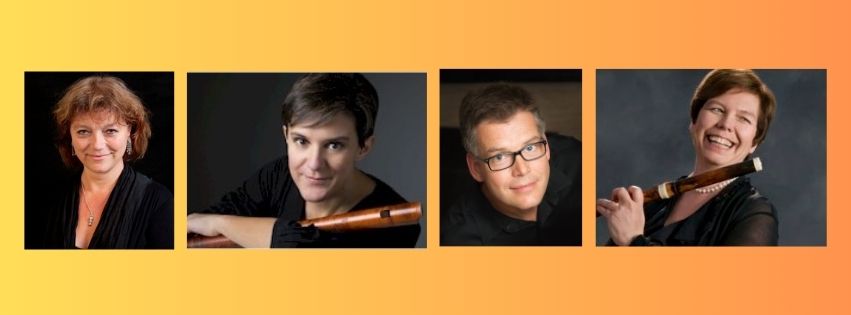
Saskia Coolen Recorder
Everything you always wanted to know about sound but were too afraid to ask!
With the help of a glass of water, a straw, and two different recorders from your own collection, we are going to explore how to improve our sound production.
What is a good sound? As early as 1535, Sylvestro Ganassi tells us the recorder should imitate the human voice. The recorder was considered the instrument closest to the voice and the breath. In this set of exercises, our recorder makes the breath audible while the water makes the breath visible! Open to: all recorder players, all levels. Pitch: A=440, 415
30.00 USD
Quantity
1
Mattheson Trios with Héloïse Degrugillier
3:00 – 4:30 pm, 7 February 2026
Héloïse Degrugillier ** Recorder
Johann Mattheson believed music should speak. Through gesture, affect, and rhetorical figures, we will shape phrasing and dialogue so the music persuades, questions, and sings. The recorder trio becomes a conversation—eloquent, expressive, and alive.
Open to: recorder players, upper intermediate to advanced. Pitch: A=440
30.00 USD
Quantity
1
Be My (Robert) Valentine – Music for Flutes & Recorders with Na’ama Lion
1:00 – 2:30 pm, 8 February 2026
Na’ama Lion Flute
Little known duets arranged by a great master: Hotteterre’s arrangements of (violin?) duets by Robert Valentine for 2 flutes. Some of these duets work well on recorders too! Beautiful music, and also an opportunity to review Hotteterre’s French ornaments, as these duets are less heavily ornamented than Hotteterre’s own music, and provide a great opportunity to ease into the language of French ornaments. Open to: flutes and recorders. Pitch: A=415
30.00 USD
Quantity
1
Music of Van Eyck with Rainer Beckmann
3:00 – 4:30 pm, 8 February 2026
Rainer Beckmann * Recorder
On pleasant summer evenings in mid-17th-century Utrecht, visitors strolling through the Janskerkhof (St. John’s Churchyard) could often enjoy Jacob van Eyck’s remarkable recorder playing. He performed elaborate sets of variations on popular tunes and psalm melodies of his time. Nearly 150 of these solo pieces survive in the two volumes of Der Fluyten Lust-hof (“The Flute’s Garden of Delight”), printed in Amsterdam between 1644 and 1649.
This class focuses on the English tunes included in Der Fluyten Lust-hof. We will explore consort settings of songs and dances by William Lawes, John Dowland, Robert Jones, and others that bear witness to the popularity of these melodies. Selected variations by van Eyck on the same tunes will further offer insight into his art of variation and compositional process. Open to: recorder players (and all instrumentalists/singers reading treble clef), intermediate and up. Pitch: A= 440Hz