
Newton Beacon Article by Greta Gaffin
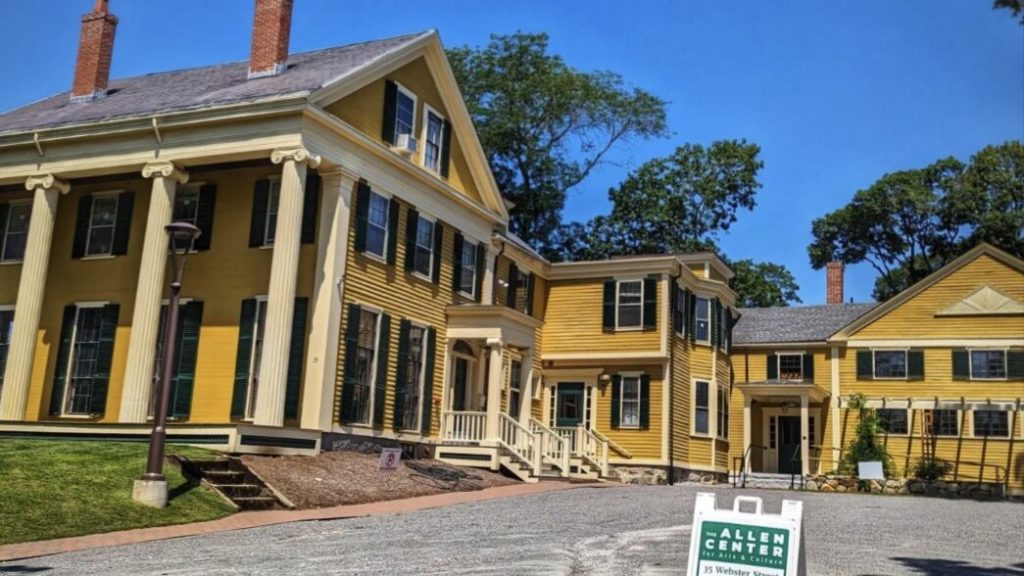
The students were also some of the first children to experience roller skates, which had been invented by Allen’s cousin James Plimpton in 1863. It attracted students from all over. It was primarily a boarding school, and black students lived alongside white students. Sometimes this caused issues. One white Southern father angrily went to visit and demanded that the black students be removed from the school, or he would remove his own son.
Allen said no, and after explaining his position, the father let his son continue attending the school. For Allen, supporting black people had always been a non-negotiable.
“Mr. Allen was a Garrisonian abolitionist, and an officer of the society when in those days it cost something to be identified with men of their belief,” wrote John Clark in 1890. This included threats of arson against him and his family.
The abolitionist Frederick Douglass had known Allen as a child, when he was warmly welcomed during visits to the family farm in Medfield. He spoke highly of the school and its schoolmaster, saying “I am glad to know that the school of which I have often heard in W. Newton is under your charge.” During Reconstruction, there were black officials in the South who sent their sons and daughters to the school, because there was no other elite education open to them.
One black alumna who went on to great service was Elizabeth Piper, who graduated in 1868. She became a schoolteacher and later university professor, and moved to Colorado in 1888 with her husband Newell Ensley (himself an alumnus of Newton Theological Seminary), where she became active in the suffrage movement for women. She helped win women the right to vote there in 1893. She also helped out-of-work miners during the Silver Panic of 1893.
Another interesting black alumna was Rebecca Crumpler. Her matriculation year is listed as 1875 in an 1893 school biographical catalogue, which notes her as “special student in mathematics.”
She was already a physician, having been awarded her degree as a “Doctress of Medicine” from the New England Female Medical College in 1864. She was one of the very few female doctors at the time, and the only black female doctor. While she had gone to the South to help treat former slaves, it was hard for her to receive respect in the South or in the North. The school catalogue also says that she was a teacher in her home state of Delaware in 1874 and 1876, so perhaps her attendance at the Allen School was a way to brush up on mathematical knowledge for her second career.
The school also fostered a sense of a desire for racial harmony among white students, in a world where even white people who supported the legal rights of African-Americans often did not see them as equals.
“It is what the scholar is capable of becoming as a free moral agent, with the help of God, that determines eligibility to membership in this school, not the mere fact that the pupil is white or black, male or female, Caucasian, Mongolian or African. For those of any race who desire to develope [sic] the good that is in every human being, there is a hearty welcome,” said Mary Greene, an alumna, who was also the second woman admitted to the bar in Massachusetts. (In addition to black students, the school also had many students from Cuba and elsewhere in Latin America, as well as one of the first Japanese people to study in the US. The Allen School prepared Tanetaro Megata so well that he was able to attend Harvard only 18 months after he arrived knowing no English.)
The school did not last long after Allen’s death, although some of his daughters ran a girls’ school in Newton through the 1940s. But his legacy was in the many good works of his graduates (the Beacon previously wrote about one alumna, who ran a school for the deaf) and in his support of efforts to promote a kinder style of education than the world of harsh punishment and rote memorization he had experienced as a child in Medfield.